
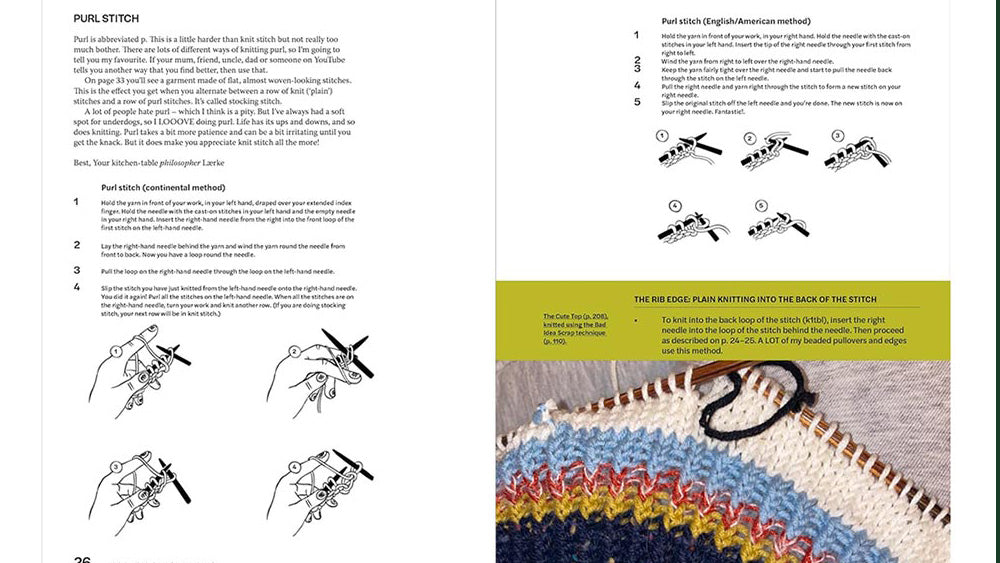
Knitting patterns are written in shorthand. Rather than spelling out every instruction in full, designers use a standardised set of abbreviations to keep patterns concise and readable. Once you know what they mean, they become second nature — but when you're starting out, or trying a pattern from a designer you haven't worked with before, a few unfamiliar abbreviations can bring a project to a halt.
This guide covers the most common knitting pattern abbreviations you'll encounter, from basic stitch instructions like k (knit) and p (purl), through to more advanced techniques such as cables, decreases, and increases. We've also included the repeat and bracket notation that patterns use to group instructions — understanding how *, () and [] work will make even complex pattern rows much easier to follow.
A few things worth knowing before you dive in: abbreviations can occasionally vary between designers and between UK and US patterns. Where two terms refer to the same technique — for example BO (bind off) and CO (cast off) — we've noted both so you won't be caught out. If you're ever unsure about an abbreviation that isn't in this table, your pattern should include its own key, usually at the front of the book or at the start of the pattern.
Full Knitting Abbreviations Reference Table
| Knitting abbreviation | Explanation |
| " | inches |
| () | work instructions between parentheses as many times as directed |
| [] | work instructions between brackets as many times as directed |
| * | repeat instructions from the single asterix as directed |
| ** | repeat instructions until double asterix as directed |
| *...* | repeat instructions between the asterixes as directed |
| alt | alternate |
| approx. | approximately |
| beg | beginning |
| bet | between |
| BO | bind off same as cast off |
| byo | backward yarn over |
| C4B | cable 4 back, slip 2 stitches purl wise onto a cable needle and keep them at the back of your work knit 2 stitches from the left needle, then knit the 2 stitches from the cable needle. |
| C4F | cable 4 front, slip 2 stitches purl wise onto a cable needle and keep them at the front of your work knit 2 stitches from the left needle, then knit the 2 stitches from the cable needle. |
| CA | colour A |
| CB | colour B |
| CC | contrasting colour |
| cdd | centered double decrease. sl2 tog, K1, pass the slipped stitches over (together) |
| ch | chain |
| cm | centimeters |
| cn | cable needle: short knitting needle, used as an aid in the twisting of a cable. |
| CO | cast on / off |
| cont | continue |
| dec(s) | decrease(s) |
| DK | Double Knitting weight yarn. |
| EON | end of needle |
| EOR | end of row |
| FC | front cross (when working a cable) |
| fl | front loop |
| foll | follow |
| g | gram (gr) |
| g st | garter stitch |
| in(s) | inch(es) |
| inc(s) | increase(s) |
| incl | including |
| k | knit |
| K1b | Knit stitch through the backloop |
| k1 f&b | knit 1 stitch in the front, then in the back |
| K1 tbl | Knit stitch through the backloop |
| kfb | knit 1 stitch in the front, then in the back |
| k tbl | Knit stitch through the backloop |
| k1 f&b | knit 1 stitch in the front, then in the back |
| k2tog | knit 2 stitches together |
| k2tog tbl | knit 2 stitches together, through the back loops |
| kb | knit stitch in row below |
| kll | knit left loop |
| krl | knit right loop |
| kwise | knitwise. Insert your needle into the stitch as if to knit it |
| LC | left cross |
| LH | left hand |
| lp(s) | loop(s) |
| LT | left twist |
| m | meter(s) or marker |
| M1 | Make one (increase) |
| M1A | make one away (increase) |
| M1L | aka M1, M1F make 1 (front)(left). An increase. From the front, lift loop between stitches with left needle, knit into back of loop English or Continental |
| M1R | aka M1B make 1 (back) (right). An increase. From the back, lift loop between stitches with left needle, knit into front of loop |
| M1T | make one towards (increase) |
| MB | make bobble |
| MC | main colour |
| mm | millimeters(s) |
| no | number |
| oz | ounce(s) |
| p | purl |
| p tbl | aka P1 tbl, P1b purl through the back loop |
| p-b | purl stitch in the row below. (infrequently used to mean purl stitch in the back loop; see p tbl) |
| p-wise | purl wise: Insert right needle down into the front loop, or up into the back loop for tbl |
| p1 f&b | aka pfb purl the front of a stitch, then purl the back of the same stitch |
| p2tog | purl 2 together |
| p2tog tbl | purl 2 together through the back loops |
| pat(s) | aka patt(s) pattern(s) |
| PM | place marker |
| PNSO | pass next stitch over |
| pop | popcorn stitch |
| prev | previous |
| PSSO | pass the slipped stitch over |
| pu | pick up stitches |
| RC | right cross (cable) |
| rem | remaining |
| rep | repeat(s) |
| rev StSt | Reverse stockinette/stocking stitch |
| RH | right hand |
| rib | ribbing: |
| rnd(s) | round(s). (specific to circular knitting) |
| RS | right side, for instance the outside of a sweater. Stated to indicate which side is facing you when carrying out instructions |
| RT | right twist (cable) |
| sk | skip |
| sk2p | slip1, knit 2 tog, pass slipped stitch over (decrease) |
| SKP | aka skpo "Slip, Knit, Pass." Slip a stitch, knit the next stitch, pass the slipped stitch over the knit one. The same as: sl1, k1, psso |
| sl | aka s slip a stitch. If they don't specify, slip the stitch purl-wise....Unless you are decreasing: then, slip it knit-wise on the knit rows, and purl-wise on the purl rows |
| sl st | slip stitch(es) |
| sl1, k1, psso | slip1, knit1, pass the slipped stitch over. The same as SKP |
| sl1p | aka sl 1 p-wise slip a stitch purl-wise |
| slip | knot an adjustable loop, used to begin many cast-on methods |
| sp(s) | space(s) |
| ss | slip stitch (Canadian) |
| ssk | slip, slip, knit slipped stitches together. A decrease |
| ssk (improved) | sl 1, sl 1 p-wise, knit slipped stitches together |
| ssp | slip, slip, purl. A decrease, usually done on the purl-side |
| sssk | slip, slip, slip, knit 3 slipped stitches together. A double decrease |
| st (s) | stitch(es) |
| st St | Stockinette/Stocking stitch |
| tbl | through the back loop |
| won | wool over needle |
| wrn | wool round needle |
| WS | wrong side, for instance the inside of the sweater. Stated to indicate which side is facing you when carrying out instructions |
| wyib | with yarn in back |
| wyif | with yarn in front |
| yb | aka ybk yarn to the back |
| yd(s) | yard(s) |
| yfon | yarn forward and over needle. Same as yo |
| yfrn | yarn forward and 'round needle. Same as yo |
| yfwd | aka yf yarn forward |
| yo | yarn over: wrap the yarn around right needle |
| yo2 | aka yo twice yarn over twice |
| yon | yarn over needle. Same as yo |
| yrn | yarn 'round needle. Same as yo |