
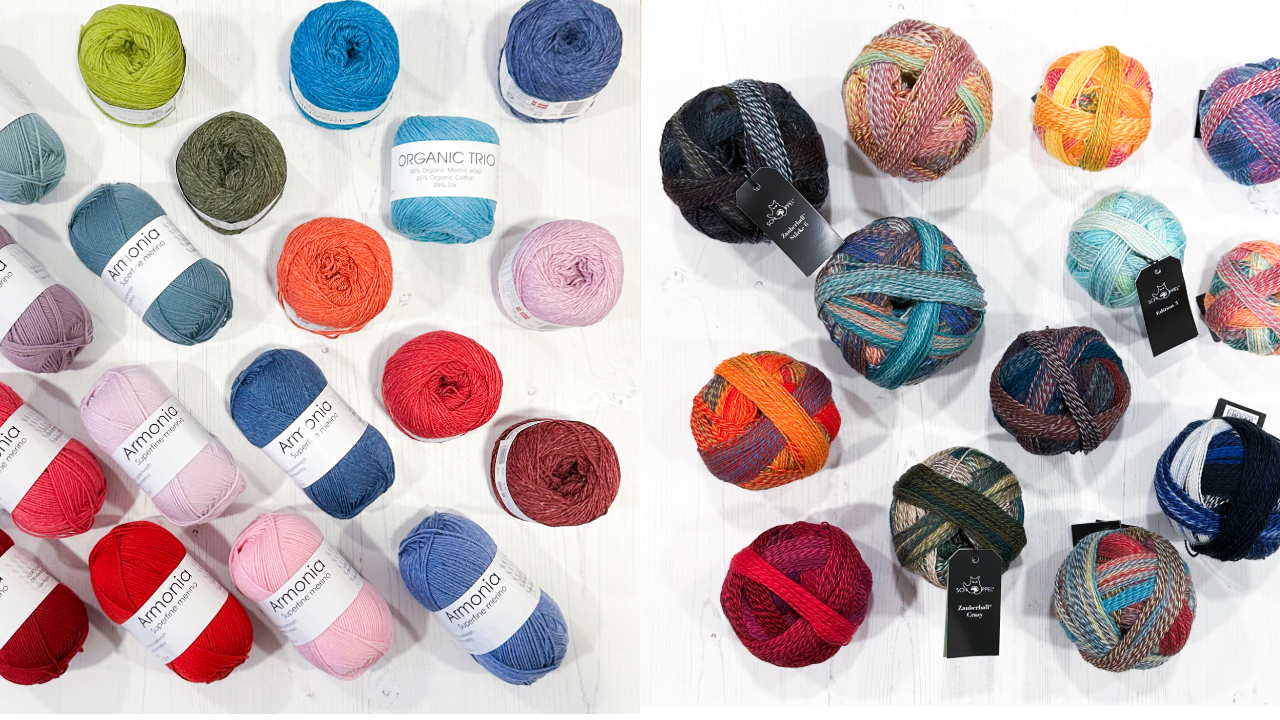
Not every yarn purchase starts with a pattern. Sometimes you just fall in love with a yarn with no plan beyond wanting it in your stash. Either way, you’re left with the same question: how much do you actually need?
This is a rough guide, not an exact one. Gauge, yarn weight, body size and pattern all move the number, sometimes by a lot, so treat these as a sensible starting point rather than a guarantee. If you do have a pattern in mind, always buy to the length stated on it.
Thilde talks through how much yarn to buy for different projects — and what to do when a special skein finds you first.
Jump to a section of the video
- Why there is no exact answer — and what to use instead 0:00
- Read the ball band: go by metres, not grams 0:52
- Hats, and what a fold-up brim costs you 3:02
- Cowls versus scarves — a scarf takes two to three times more 4:30
- Socks: when one 100g ball is enough 5:26
- Baby blankets 7:22
- Jumpers, and why size changes everything 7:58
- Buying a souvenir skein on holiday 8:58
- Making a special skein go further with mohair 10:22
- Dye lots: when to buy the extra ball 11:07
Every point Thilde makes is written out below too, so you can read it instead of watching if you prefer.
Why the same weight category doesn’t always mean the same length
The tables below group yarn by weight category, but “DK” or “4ply” describes the thickness of the strand, not a fixed length per ball, and fibre and construction can move that length a long way. Two 50g balls both labelled DK can hold quite different amounts of yarn on the inside.
Take Hjertegarn Organic Trio as an example. It’s a light DK, but each 50g ball holds 230m (252yd), roughly double what a typical DK yarn gives you from the same weight. That’s the combination of its three fibres, organic merino wool, organic cotton and silk, spun and plied in a way that packs more length into the same weight of fibre than a standard worsted-spun DK.
Lang Yarns Cashmere Premium makes the same point from the other direction. Cashmere is an exceptionally light, fine fibre, so it is usually sold in 25g balls rather than 50g. Each 25g ball holds 115m (126yd), which is the length you would expect from a whole 50g ball of a standard DK. Half the weight in your hand, the same amount of yarn on the inside. Put another way, both Organic Trio and Cashmere Premium give you roughly 4.6 metres of yarn per gram, where a standard DK gives you about 2.3.
The practical upshot: the tables below are a starting point based on typical length for each weight category, but the number on the ball band always wins. Before buying, check the metres or yards per 50g or 100g on the label, and use that figure rather than the weight-category average if the two don’t match.
A rough guide by project and weight
These figures are for a single, solid colour. If you’re planning stripes, colourwork or holding two yarns together, see the notes below the table.
| Project | 4ply / Fingering | DK | Aran / Worsted | Chunky |
|---|---|---|---|---|
| Hat, adult | 300–400m 330–440yd | 200–300m 220–330yd | 140–220m 150–240yd | 100–180m 110–200yd |
| Hat, baby or toddler | 150–200m 160–220yd | 100–180m 110–200yd | 100–130m 110–140yd | 80–100m 90–110yd |
| Cowl (approx 60cm circumference) | 235–315m 260–340yd | 175–235m 190–260yd | 145–200m 160–220yd | 115–155m 130–170yd |
| Scarf (approx 200cm long) | 800–1050m 870–1150yd | 600–800m 660–870yd | 500–700m 550–770yd | 400–500m 440–550yd |
| Mittens or gloves | 150–260m 160–280yd | 120–220m 130–240yd | 100–180m 110–200yd | 80–150m 90–160yd |
| Socks (pair) | 300–400m 330–440yd | 250–370m 275–400yd | 250–340m 275–375yd | Rarely used |
| Baby cardigan or jumper, up to 9 months | 400–500m 440–550yd | 300–400m 330–440yd | 250–350m 270–380yd | Rarely used |
| Baby blanket, pram (55 × 70cm) | 650–800m 710–870yd | 575–690m 630–750yd | 500–600m 550–660yd | 375–450m 410–490yd |
| Baby blanket, cot (70 × 90cm) | 1050–1200m 1150–1310yd | 920–1035m 1010–1130yd | 775–875m 850–960yd | 600–675m 660–740yd |
| Throw or blanket | 1500–2000m 1640–2190yd | 1200–1800m 1310–1970yd | 1300–2000m 1420–2190yd | 1000–1500m 1090–1640yd |
Work out the metreage from a pattern you already know and like, then use that as your own personal reference for future projects in the same weight. Your own tension and habits matter more than any table.
A scarf typically needs two to three times what a cowl does of the same weight, since a scarf worked flat can run to 200cm or more in length, where a cowl only needs to cover its circumference, often around 60cm; a longer or wider version of either will need more than the figures above. For socks, a single standard 100g ball of 4ply sock yarn, commonly around 400m, comfortably covers a pair up to men’s UK size 11–12; Regia’s own guidance confirms one ball is enough at that size.
Adult jumper, by size
Sizing has the biggest effect on quantity of any variable in this guide, so it gets its own table, from XS through to 5XL.
| Size | 4ply / Fingering | DK | Aran / Worsted | Chunky |
|---|---|---|---|---|
| XS | 1010–1280m 1100–1400yd | 910–1130m 1000–1240yd | 710–860m 780–940yd | 660–820m 720–900yd |
| S | 1100–1330m 1200–1450yd | 1010–1230m 1100–1340yd | 790–910m 860–1000yd | 700–880m 770–960yd |
| M | 1230–1510m 1350–1650yd | 1150–1410m 1260–1540yd | 900–1080m 980–1180yd | 760–1000m 830–1090yd |
| L | 1510–1800m 1650–1970yd | 1410–1680m 1540–1840yd | 1080–1280m 1180–1400yd | 800–1090m 870–1190yd |
| XL | 1650–1980m 1800–2170yd | 1550–1850m 1700–2020yd | 1190–1410m 1300–1540yd | 880–1130m 960–1240yd |
| 2XL | 1870–2190m 2050–2400yd | 1740–2050m 1900–2240yd | 1350–1570m 1480–1720yd | 990–1220m 1080–1330yd |
| 3XL | 2010–2470m 2200–2700yd | 1960–2340m 2140–2560yd | 1460–1740m 1600–1900yd | 1090–1260m 1190–1380yd |
| 4XL | 2240–2700m 2450–2950yd | 2050–2470m 2240–2700yd | 1630–1920m 1780–2100yd | 1200–1390m 1310–1520yd |
| 5XL | 2380–2930m 2600–3200yd | 2250–2690m 2460–2940yd | 1720–2030m 1880–2220yd | 1300–1520m 1420–1660yd |
These figures assume a fairly standard fit and length in plain stocking stitch. A cropped or fitted design needs less; an oversized or longline one needs more, sometimes a full size band’s worth more. Textured and cabled knits need more too, since the stitches pull in and the fabric needs extra length to compensate, so allow extra on top of these figures for anything heavily cabled or richly textured. If you’re between two sizes, buying to the larger figure is the safer choice, since running short partway through a body is far more disruptive than having a little left over.
Not sure which weight category your yarn falls into? Our Yarn Weights Chart & Guide explains the categories and how to read a ball band.
Buying yarn on holiday, with no pattern yet
Souvenir yarn is its own category, and it doesn’t need to follow the table above. If you’re buying a single special skein to remember a trip, one skein is enough. Think of it as a keepsake first and a project second: a small accessory, a pair of mitts or a small neckerchief will all live happily in a single 100g ball. Choose 4ply over DK if you want that skein to stretch furthest, since a finer yarn holds more length in the same weight and covers more ground before it runs out.
If you’d like the option of something slightly bigger, such as a cowl or a hat, 150–200g of the same dye lot gives you room without much financial commitment. Beyond that, it’s worth pausing. If you’re tempted by three or more skeins of an unfamiliar yarn with no plan, ask yourself whether you’d buy the same amount of a yarn you already knew. It is not as though you can return or exchange it once you are back home, and dye lots from small producers often can’t be matched again, so buying “just in case” a project appears later is a common way stash grows faster than plans do.
Making expensive, hand-dyed yarn go further
Hand-dyed yarn is priced for the time and skill that goes into it, and a full jumper’s worth is a genuine investment. If the budget doesn’t stretch that far, the yarn doesn’t have to sit in the stash waiting for it to. A little goes a long way when it’s placed somewhere it will be seen, and it can be great fun playing around with a design in this way.
- A colourwork yoke. One or two skeins of a special hand-dyed yarn worked into the yoke of an otherwise plain jumper puts the colour exactly where it’s noticed most, without needing enough for the whole garment.
- Contrast cuffs, hem and neckband. Use a contrasting colour for the cuffs, hem and neckband. This way you can also add a softer yarn if the one purchased is a little on the rough side.
- Stripes against a plain base. Even a single skein, striped in at intervals against a plain, affordable main colour, stretches a small amount of special yarn across an entire garment.
- Accessories that pair with something bigger. A hat, cowl or pair of mitts in the hand-dyed yarn, knitted to match a plain jumper or coat, gets more wear out of a single skein than the same skein tucked into one project alone.
- Hold it with mohair. Holding a fine mohair alongside your hand-dyed yarn thickens the strand, so you work it at a different tension on larger needles and cover more ground with every metre. A 100g 4ply skein is around 400m, and held with mohair it behaves like a DK, which against the DK column above is an adult hat with yarn to spare, a generous cowl, or a hat and mitts together. What mohair really changes is the fabric: it brings a soft halo that blurs the colour beautifully, especially on a variegated or speckled skein, and it will take the edge off a yarn that turned out rougher than it looked in the shop. Knitting for Olive Soft Silk Mohair is our usual choice for this, and the shade you hold with it is worth some thought. The aim is to find a colour that brings out the best in the skein, which is often a bold one rather than a safe neutral. With a variegated or speckled yarn, picking a mohair in one of the colours already in the skein will pull that shade forward through the whole fabric, and it is worth holding a few options against the yarn in daylight before you commit.
Yarns mentioned in this guide

Hjertegarn
Organic Trio
Light DK with an unusually generous 230m per 50g ball — organic merino, cotton and silk.
Shop Organic Trio
Lang Yarns
Cashmere Premium
Featherlight pure cashmere — 115m from every 25g ball, the length of a standard 50g DK.
Shop Cashmere Premium
Knitting for Olive
Soft Silk Mohair
Our favourite mohair to hold alongside a special skein — a soft halo that makes every metre go further.
Shop Soft Silk MohairA word on dye lots
Hand-dyed and small-batch yarn varies from batch to batch, sometimes noticeably. If there’s any chance you’ll want more later, for a bigger version of the same project or to extend it, buy it all in one visit if you can. A dye lot you loved may not be there, or may not match, when you go back for it. If you’re not sure how much a project will take, it’s almost always better to buy one skein more than the table suggests than to run one skein short and have to introduce a slightly different shade partway through.